
 Available in US
Content
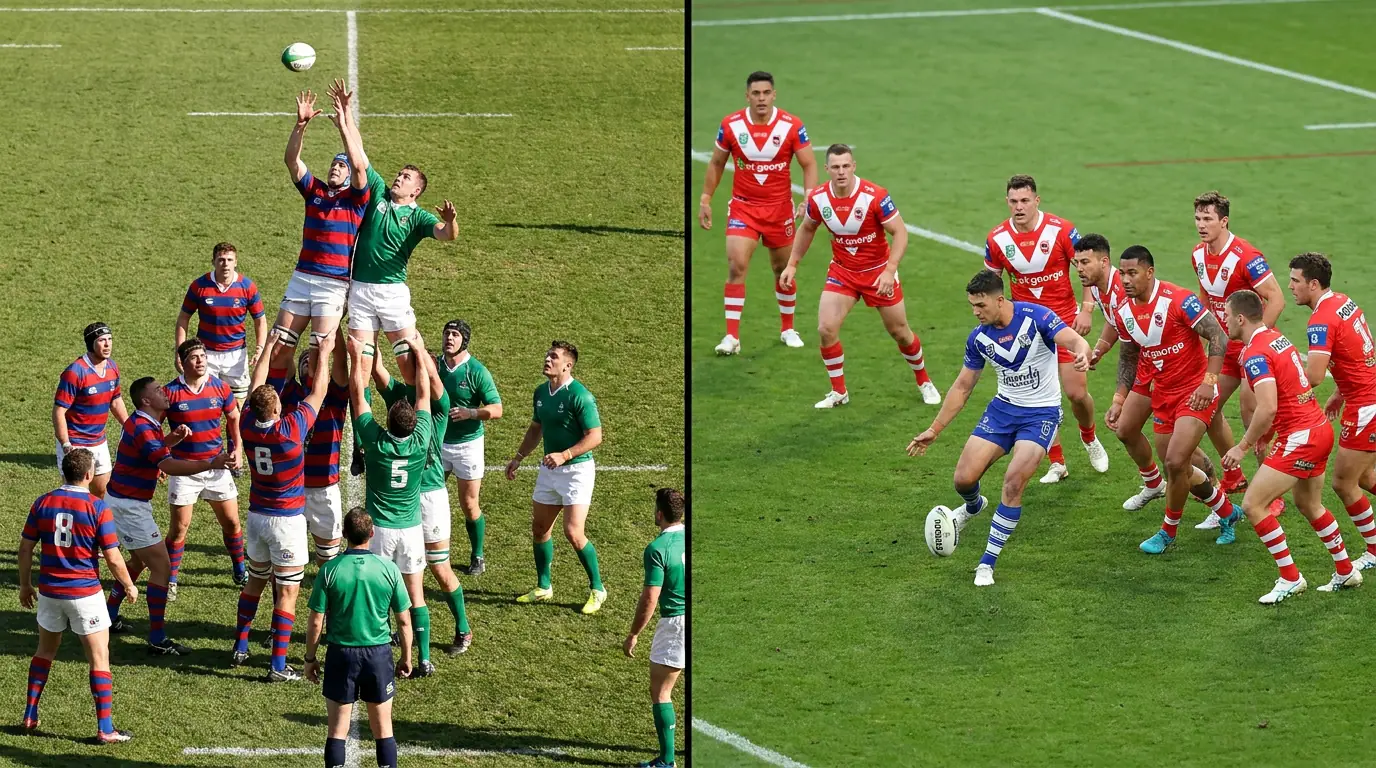
I backed a Super League total once using union logic and lost before halftime. The line was set at 42.5, which felt generous based on how I was used to seeing Premiership rugby score. Except league scores differently — tries are worth four points, not five, but they come at a pace that union simply does not match. The game ended 28-22 and the over landed comfortably, but not because of any clever analysis on my part. I had stumbled into profit despite a fundamental misunderstanding, and that sort of luck does not repeat itself.
The distinction between rugby union and rugby league betting is not a footnote or a preference. These are structurally different sports with different scoring systems, different game tempos and different market dynamics. Super League drew 1.62 million fans in 2025 — a twelve-team era record — with television audiences up 52%, which means the league market is growing in visibility and liquidity. If you bet both codes, you need to understand both codes. And if you only bet one, you are leaving money on the table by ignoring the other entirely.
Scoring Systems and What They Mean for Totals Markets
Here is the core mechanical difference that changes everything about how you approach totals. In union, a try is worth five points with a two-point conversion available. In league, a try is worth four points with a two-point conversion (goal) also available. Penalty goals in union are worth three points; in league, penalty goals are worth two. Drop goals are three in union, one in league. These arithmetic differences cascade through every totals line you ever look at.
Union matches at Premiership level average roughly 40-50 total points, but that average masks enormous variance. A wet day at the Stoop can produce a 12-9 trench war, and a dry afternoon at Sandy Park can finish 45-38. League scoring is higher on average but more compressed in range. A typical Super League match lands between 36 and 52 total points, and the distribution clusters tighter around the mean because league’s faster play-the-ball mechanism and limited tackle count (six tackles before turnover) produce a more predictable rhythm of scoring opportunities.
The practical upside for bettors is that league totals are easier to model with basic statistics. Union totals require you to account for scrum dominance, lineout accuracy, weather, and the referee’s tolerance for breakdown penalties — variables that are harder to quantify. When I switched from union-only to dual-code betting, my totals strike rate improved specifically because league gave me a more predictable dataset to work with. That predictability does not mean the lines are soft — bookmakers know the same thing — but it means your edge comes from identifying the matches that deviate from the pattern, and those deviations are easier to spot when the baseline is stable.

Market Depth and Where Each Code Offers More Value
I remember trying to place a try scorer bet on a Challenge Cup match in 2021 and finding exactly one operator with the market available. That has changed — dramatically. UK bettors now place roughly 290 million online wagers per month across all sports, and rugby league’s share of that volume has grown alongside the sport’s television profile. But the market depth gap between the two codes remains meaningful, and it cuts both ways.
Union markets, especially for internationals and the Six Nations, are deep. You can find handicap spreads, total points, try scorer, winning margin, half-time/full-time, player props and bet builder options across multiple operators. The Six Nations alone generates media revenues exceeding $135 million, and that commercial weight translates into tight, efficient pricing. Finding value in a Six Nations match requires genuine analytical edge because the lines are sharp and the money is heavy.

League markets are thinner, particularly below Super League level. Championship and League 1 matches may only offer match result and basic handicap. Even at Super League level, the range of available markets is narrower than for a Premiership union fixture. This matters because thinner markets mean less efficient pricing. When fewer bettors and fewer sharp syndicates are involved in setting a line, the price discovery process is less rigorous, and soft lines survive longer. I have found consistently better value on Super League handicaps than on equivalent Premiership handicaps — not because I know league better (I do not) but because the market itself is less efficient.
The flip side is liquidity. If you are betting significant stakes, union markets absorb volume more easily. A large bet on a Six Nations handicap barely moves the line. The same stake on a Friday night Super League match can shift prices noticeably, and that visibility can cost you if you are not careful about timing your bets. For a deeper look at how to compare rugby odds across operators, understanding the liquidity difference between the two codes is essential context.

Tactical Tempo and Its Impact on Live Betting
Watch a league match and then immediately watch a union match. The difference in tempo is not subtle — it is like switching from basketball to chess. League’s play-the-ball is faster than union’s ruck and recycling process. Stoppages in league are shorter and less frequent. The clock runs more continuously, and scoring events arrive at shorter intervals. This has direct consequences for in-play betting.
In league, live markets move faster because scoring happens more frequently and more suddenly. A line break in league often leads directly to a try because there are fewer defensive players in the line (thirteen per side versus fifteen in union) and the defensive structures are more stretched. If you are betting in-play on league, you need to react quickly and understand that momentum swings happen faster and reverse faster than in union. A two-try deficit in league can be erased in ten minutes of sustained pressure; in union, the same deficit often requires territorial dominance sustained over twenty minutes or more.
Union in-play betting rewards patience. Penalty accumulation, scrum dominance and territorial position are slow-building advantages that gradually express themselves in the scoreline. You can watch a union match develop for thirty minutes before the price reaches the threshold where the pre-match value you identified becomes available in-play. In league, that window is narrower. The price you want may exist for seconds between scoring events, and the lag in live odds updating can work for you or against you depending on how quickly you react.

My approach to the two codes is different at the execution level even when the analytical process is similar. For union, I identify value pre-match and then wait for in-play confirmation before committing full stake. For league, I commit more stake pre-match because the in-play markets move too fast for me to gain consistent execution advantage. The global sports betting market generates $82 billion in annual revenue, and the portion of that flowing into live rugby markets is growing — but the operational demands of in-play betting differ sharply between the codes.
Switching Codes Without Switching Off Your Brain
The biggest mistake dual-code bettors make is treating one code’s principles as universal. Union’s home advantage is roughly 64% at Premiership level. League’s home advantage exists but manifests differently because league’s salary cap structure creates greater competitive balance across the division, compressing the quality gap between top and bottom sides. A Premiership bottom-feeder can lose by 50 at a top-four ground; a Super League bottom side rarely loses by more than 30 because the squad quality differential is smaller.
Handicap expectations need recalibrating when you cross codes. A 12-point union handicap represents a comfortable but not dominant performance. A 12-point league handicap, given the four-point try value and faster scoring tempo, represents a narrower advantage than the raw number suggests. I keep separate models and separate staking logs for each code — blending them introduces noise that erodes whatever edge you have built in either one.
The reward for this discipline is access to twice as many betting opportunities across the season. Union’s calendar fills autumn through spring; league runs spring through autumn. Between the Premiership, Six Nations, Super League and international windows, there is barely a weekend without meaningful rugby to analyse. The bettors who treat both codes with equal seriousness are the ones who keep their analytical skills sharp year-round rather than going dormant during the off-season of whichever code they prefer.

Can I use the same betting strategy for rugby union and rugby league?
Not directly. The scoring systems, game tempos and market dynamics differ significantly. Totals lines, handicap expectations and in-play timing all require code-specific adjustments. The underlying analytical principles (value identification, bankroll management) transfer, but the specific models and thresholds need to be calibrated separately for each code.
Which code offers better value for rugby bettors?
League markets tend to be less efficient because they attract less betting volume and fewer sharp bettors, which can mean softer lines. Union markets are deeper and more liquid, which benefits higher-stakes bettors. The best approach is to bet both codes and take value wherever you find it rather than committing exclusively to one.
Are try scorer markets available for rugby league matches?
Yes, most major UK operators now offer anytime and first try scorer markets for Super League matches. The range is narrower than for union internationals, and availability can be limited for lower-tier league competitions like the Championship.
