
 Available in US
Content
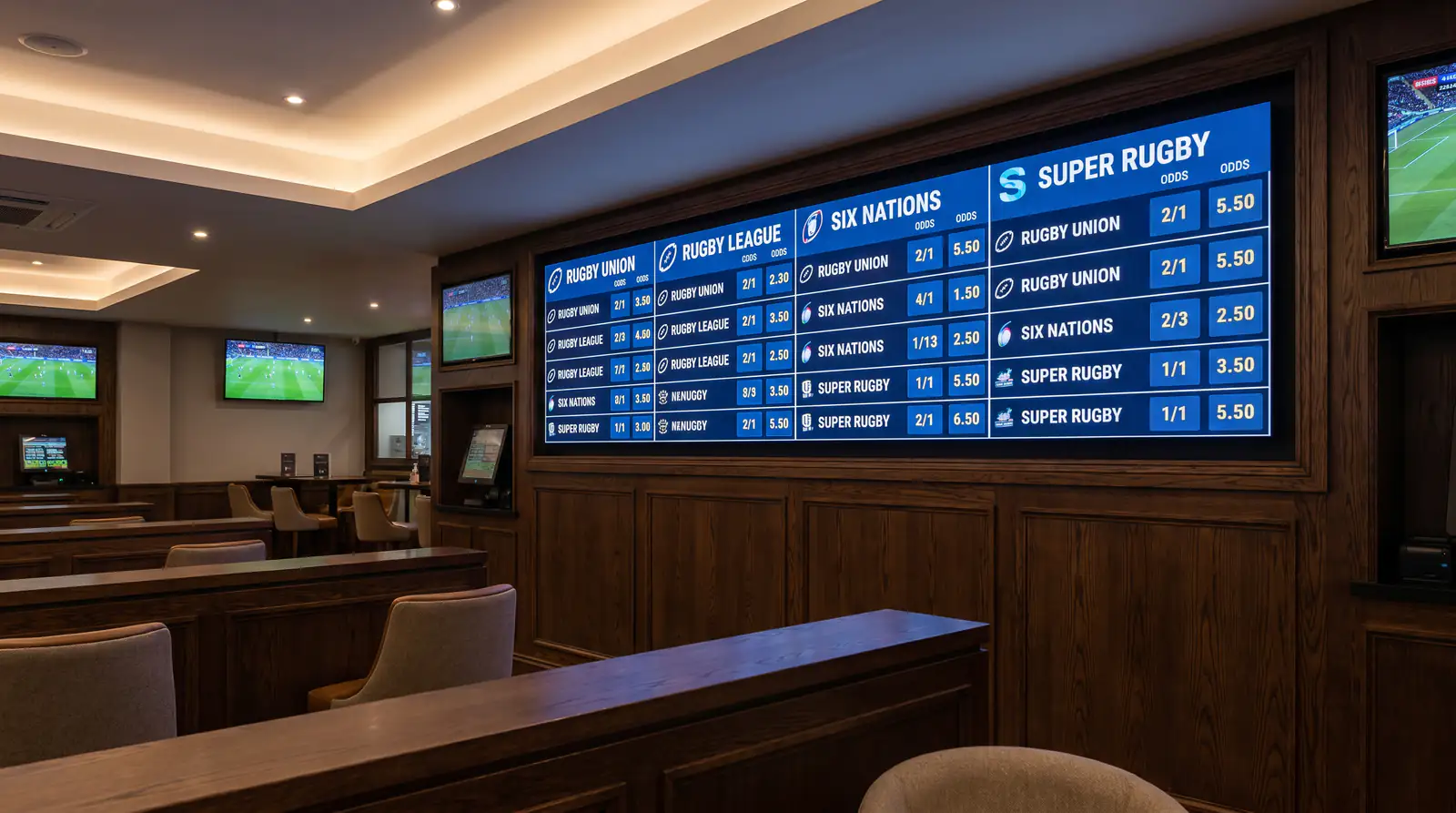
Sports betting accounts for 57.1% of all UK online gambling revenue — the largest segment by a wide margin — and rugby contributes a growing share of that total. Yet walk into any conversation about rugby betting and you will hear the same handful of markets discussed over and over: match winner, maybe a handicap, occasionally an accumulator. The full range of markets available to a UK rugby bettor is far broader than most people realise, and understanding each one is the foundation for making informed decisions about where to put your money.
This guide is the reference I wish I had when I started. It covers every major rugby market type, explains how each one works, and points you toward the deeper analysis available in our specialist guides. Think of it as a map of the territory — not a deep dive into any single region, but a clear view of the landscape so you know what is available and where to focus your research.
Pre-Match Markets: Match Result, Handicap, Totals and More
Every month, UK bettors place roughly 290 million online wagers on real events, and pre-match markets absorb the largest share of that volume. Pre-match simply means the bet is placed before kick-off, and the range of options has expanded dramatically over the past five years.
Match result is the simplest market: pick the winning team, or the draw in competitions where draws are possible (primarily in League). In Union, most domestic and international matches must produce a winner through extra time or a kicking shootout, so the draw option is absent from many Premiership and international fixtures. The match result market is where the bookmaker’s margin is thinnest because it attracts the most volume, but for the same reason, finding value is harder than in less popular markets.

Handicap betting levels the playing field by applying a points advantage or disadvantage to one team. A handicap of -7.5 on the favourite means they must win by eight or more points for your bet to land. This market is essential for matches where one side is a heavy favourite and the match result price offers no value. Handicap lines in rugby are typically set in multiples of 0.5 to eliminate draws, though some bookmakers offer whole-number handicaps with a void-on-draw clause.

Totals (over/under) let you bet on the combined score of both teams without caring who wins. The bookmaker sets a line — say 44.5 — and you bet on whether the total points scored will be over or under that number. Totals are influenced heavily by weather, surface, and playing style, and they reward bettors who study match conditions rather than just form.
Half-time/full-time is a dual-result market where you predict the leader at half-time and the winner at full-time. Nine possible outcomes (home/home, home/draw, home/away, and so on) create longer odds and wider margins, but also more room for analytical edge, particularly if you have a view on how a match will unfold tactically.
Winning margin asks you to predict the exact margin of victory, typically grouped into bands: 1-5 points, 6-10, 11-15, 16-20 and so on. This market rewards close students of scoring patterns and is particularly useful in competitions where margin distributions are predictable — the Premiership, with its 33% of matches finishing within seven points, is an ideal hunting ground.
Player Markets: Try Scorer, Points Scorer and Man of the Match
Player markets transform rugby betting from a team sport into an individual one. They are among the most popular markets with recreational bettors and, counterintuitively, among the most analytically exploitable because bookmaker pricing relies on name recognition as much as data.
Try scorer markets come in three flavours: first try scorer (the player who scores the opening try), last try scorer, and anytime try scorer (at least one try during the match). First and last try scorer carry the longest odds and highest variance; anytime is more forgiving but priced more tightly. The key to try scorer betting is understanding team structure — who stands where in the attacking line, who finishes set-piece moves, who occupies the edge channels — rather than simply picking the fastest or most famous player.

Points scorer markets (player to score X or more points) are dominated by kickers. A reliable fly-half who lands penalties and conversions will quietly accumulate 15-20 points in a high-scoring match, and the odds on “player to score 15+ points” can offer genuine value when the match conditions favour a kicking-heavy approach. I check the kicking stats of both fly-halves before every match — a kicker’s success rate under pressure is one of the best predictive stats in rugby.
Man of the match is a subjective market where the payout depends on an official adjudicator’s decision. This makes it inherently unpredictable, and I generally avoid it unless the adjudicator’s historical tendencies are known — some favour backs, some favour forwards, some default to try scorers.
Specials, Futures and Outrights
Beyond individual matches, rugby betting offers a rich set of futures and outright markets that operate on longer time horizons. These are the bets you place weeks or months before the outcome is decided, and they reward patience and early analysis.
Tournament outrights — who will win the Six Nations, Premiership, Super League, World Cup — are the most familiar futures markets. They open well in advance of the competition and the odds shift as results unfold. The best value in outrights typically appears before the competition begins, when the market is at its least informed and prices are widest. As each round passes, the market incorporates new information and prices converge toward efficient levels.

Top try scorer and top points scorer outrights run across an entire tournament or season. These markets are heavily influenced by how many matches a player features in, so injury risk and rotation policies matter as much as raw talent. I weight game time probability at 40% and per-game scoring rate at 60% when assessing these markets.
Relegation and promotion specials apply to domestic leagues. The Premiership relegation market, for instance, asks you to pick which team will finish bottom at the end of the season. These markets move slowly because the outcomes take months to resolve, and they can offer outstanding value if you identify a team in structural trouble (coaching changes, financial issues, player departures) before the market catches on.

Bet builders and same-game multis allow you to combine multiple selections from a single match into one bet. They are a relatively new product that has become enormously popular, and they carry their own distinct pricing dynamics. For a detailed breakdown of how bet builders work and where the hidden margins sit, the in-play betting guide covers live market mechanics that intersect with bet builder strategy.

What is a rugby bet builder and how does it differ from an accumulator?
A bet builder combines multiple selections from a single match — for example, match winner plus first try scorer plus over 40.5 total points — into one bet. An accumulator combines selections from different matches. The key difference is correlation: legs within a bet builder are often correlated (a high-scoring match makes both overs and certain try scorer picks more likely), and bookmakers adjust the combined odds to account for that correlation. Accumulators assume independent events.
Which rugby market has the lowest bookmaker margin?
Match result typically carries the lowest margin because it attracts the highest volume of bets, which allows bookmakers to operate on thinner margins while still generating profit. Handicap markets are usually the next-tightest. Player markets, specials and exotic bets carry the widest margins because they attract less volume and require more subjective pricing from bookmaker traders.
